Denmark's Climate Success Is Breaking Its Own Grid
The country built one of the world's most advanced renewable energy systems. Now it needs to solve a harder problem: teaching millions of devices to use electricity at the right moment.
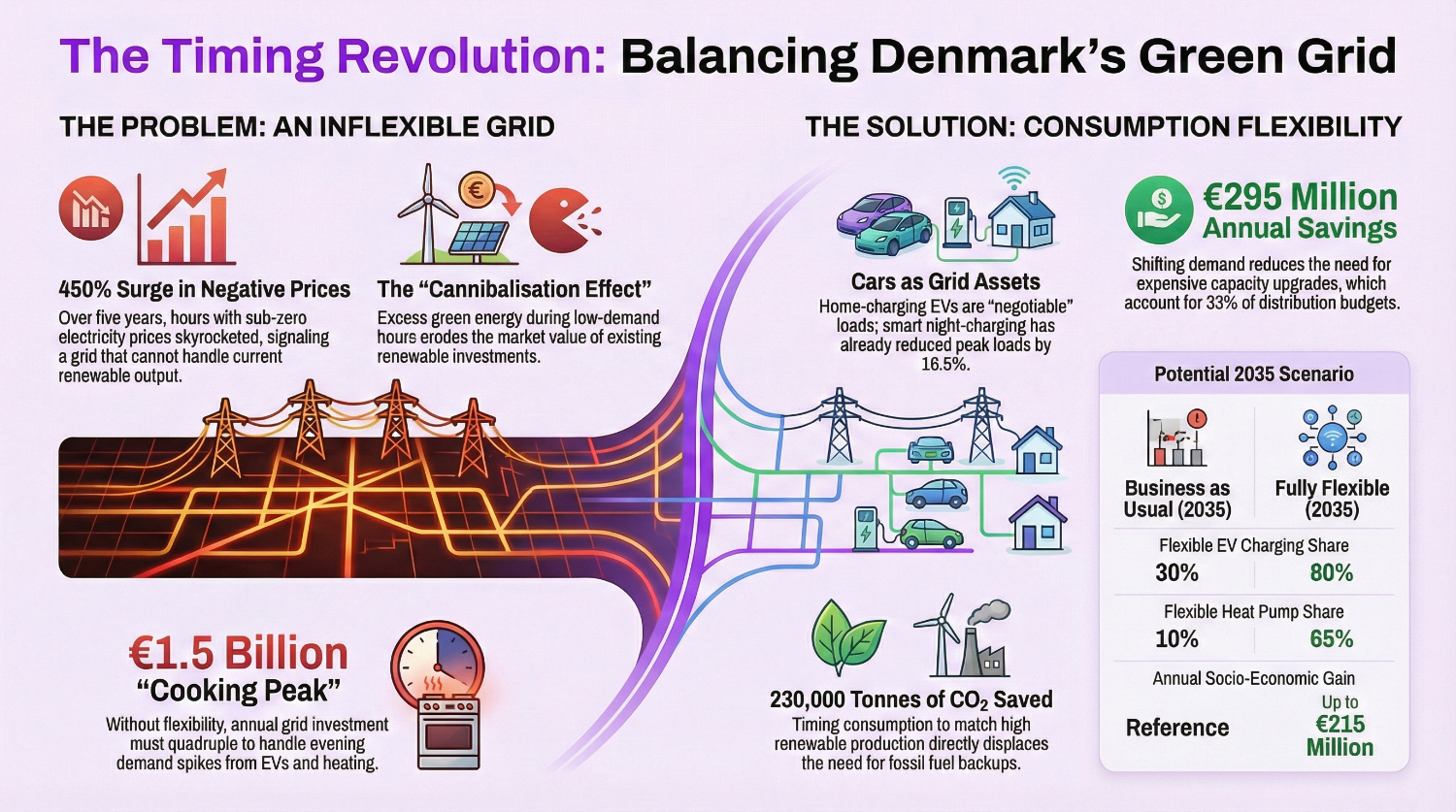
Over the past five years, the number of hours during which Danish electricity prices have dropped below zero has increased by 450%. This may sound like a win for consumers. In fact, it is a structural warning signal. It shows that a grid designed for the fossil fuel era cannot handle the amount of renewable energy that is produced today. According to a major 2025 analysis by Copenhagen Economics and the CIP Foundation, the solution does not lie in installing more turbines or larger cables. Rather, it is a wholesale transformation in how and when Denmark consumes power. This shift is estimated to be worth up to DKK 1.6 billion a year.
When Success Breaks the Market
The mechanics of the problem explain why the conventional approach of building more renewable energy sources and celebrating falling costs is no longer sufficient on its own.
As weather-dependent sources replace conventional power plants, it is becoming increasingly difficult to control the supply side of Denmark's grid. Wind doesn't negotiate with demand curves. When production surges during low-demand hours, prices collapse, sometimes into negative territory, in what energy experts call the cannibalisation effect. New renewable capacity erodes the market value of existing renewable capacity.
The implication is uncomfortable. Denmark's green investments are, in a narrow but real economic sense, undermining the business case for future green investments. Every new turbine added to an inflexible system pushes the price floor lower during periods of oversupply, while doing nothing to address the structural shortage during calm, high-demand hours when fossil backup still gets called.
The fix is on the demand side. It is measured in billions.
Car as a Grid Asset
The most undervalued grid asset in Denmark is parked in the garage.
Between 60% and 84% of Danish EV owners charge their vehicles at home. Most plug in overnight, leaving the car connected far longer than a full charge requires. That idle time, the gap between "plugged in" and "fully charged," is the raw material for what the energy sector calls consumption flexibility: the ability to shift when power is drawn without changing how much is drawn.
This is not a theoretical capability. Danish consumers using smart night-charging have already demonstrated a 16.5% reduction in peak loads. The car charges. The driver notices nothing. The grid breathes.
Home charging is particularly potent because it happens "behind the meter," inside the home's own energy boundary, where intelligent software can optimise when current flows before it ever becomes the grid operator's problem. Curbside public charging is driven by immediate necessity: the battery is low, the driver is in a hurry. Home charging is governed by a deadline: the car needs to be ready by morning. Everything between plug-in and deadline is negotiable.
Heat pumps operate on a similar logic. The house doesn't need to be heated at a specific minute. It needs to stay within a temperature band. The timing is flexible. The comfort is not.
The €1.5 Billion Question
Denmark's distribution grid currently requires about €400 million per year in investment. That figure is about to change. The simultaneous electrification of transport, heating, and parts of industry is creating what grid planners call the kogespidsen, literally the "cooking peak," that window in the early evening when household demand, EV charging, and heat pump operation converge on the same cables at the same time.
To accommodate that peak through conventional infrastructure expansion, forecasts project that annual grid investment will need to rise to €1.5 billion for the period 2031–2040. Nearly quadruple the current rate, almost entirely to handle a few hours of simultaneous demand.
Consumption flexibility attacks the problem directly. Spread the same total demand across a wider timeframe to reduce the peak. By reducing the peak, you can defer or eliminate the most expensive category of grid investment, which is capacity upgrades.
That category accounts for roughly 33% of all distribution investments. In a fully flexible scenario, where 80% of EV charging and 65% of heat pump operation responds dynamically to price and grid signals, the savings reach an average of €295 million per year across the transmission and distribution networks between 2026 and 2035.
Where those grid investments go, specifically:
New connections cover infrastructure for new housing developments and solar parks, necessary regardless of flexibility.
Reinvestments replace worn-out cables and aging components, also largely fixed.
Capacity upgrades are the target: spending driven purely by peak load, the category that flexibility can shrink or defer entirely. A third of the distribution budget.
Green Energy Has a Timing Problem
The climate argument for flexibility is distinct from the economic argument, and equally sharp.
When Danish electricity demand peaks during periods of low renewable production, such as calm, cold winter evenings, the grid relies on fossil fuel backup. Gas plants start up. Imported power from coal-reliant neighbours flows in. The carbon intensity of a kilowatt-hour at 6 p.m. on a calm January evening is much higher than at 3 a.m. during a North Sea gale.
Flexibility, in the form of shifting consumption towards hours of high renewable output, can directly displace fossil fuel sources. In a fully flexible scenario, Denmark could reduce its annual CO₂ emissions by up to 230,000 tonnes. It won't be achieved through new generation capacity or carbon capture. However, timing is key.
Flexibility also increases the effective utilisation of renewable assets that already exist. Wind turbines that would otherwise be curtailed during oversupply instead serve real demand. Solar panels whose midday output exceeds midday consumption find a use in pre-heated water tanks and pre-charged vehicles. The renewable infrastructure becomes worth more without a single new installation.
Habit Won't Scale - Automation Will
The path from today's grid to a flexible one is not technically mysterious. The hardware is largely deployed, including electric vehicles (EVs), heat pumps and smart meters. What's missing is the software layer that translates volatile price signals into automated device behaviour, invisibly and at scale.
The gap between current reality and full potential:
| Business as Usual (2035) | Fully Flexible (2035) | |
|---|---|---|
| Flexible share of EV charging | 30% | 80% |
| Flexible share of heat pumps | 10% | 65% |
| EV time-shift window | ±4 hours | ±5 hours |
| Traditional consumption shift window | ±2 hours | ±6 hours |
| Annual socio-economic gain | Reference | Up to €215 million |
The "Business as Usual" column is not a failure scenario. It represents today's smart-charging technology scaled to 2035 adoption levels. The "Fully Flexible" column is what becomes possible with genuine automation: systems that respond to real-time price signals without requiring the consumer to check an app, override a schedule, or think about electricity at all.
The total socio-economic gain of moving from one column to the other is estimated at €80 to 215 million annually. Most of that flows to consumers as lower energy bills, up to €190 million in aggregate. But the impact is not uniform. Some flexible producers, such as Power-to-X facilities that depend on cheap surplus electricity, may see costs rise modestly (around €13 million) as increased competition for low-price hours lifts the price floor during those windows.
A higher price floor during previously negative-price hours improves the investment case for new renewable capacity, the same investment case that the cannibalisation effect has been eroding. The system corrects itself.
No Subsidies Required
Consumption flexibility does not require public subsidy.
The mechanism is market-driven. Volatile prices are the signal. Software is the response. Consumers benefit through lower bills. Grid operators benefit through deferred capital expenditure. The climate benefits through higher renewable utilisation and lower fossil dispatch. The price spread between peak and off-peak hours already provides sufficient incentive, and that spread is widening as renewable penetration increases.
What is needed is the connective tissue: the software platforms, the communication protocols, the regulatory frameworks that allow devices to respond to price signals automatically and securely. The infrastructure of a flexible grid is not made of copper. It is made of data and timing.
Denmark has already proven that a modern economy can run primarily on wind and solar power. The next challenge is more difficult and less photogenic: ensuring that millions of distributed devices, such as chargers, heat pumps and water heaters, as well as industrial processes, can learn to consume energy in rhythm with a grid that produces power according to the weather, rather than according to our schedule.
The 450% increase in negative-price hours is not a problem to be solved by more turbines. It is a signal, persistent and increasingly expensive to ignore, that the demand side of the energy system needs to become as intelligent as the supply side already is.